Best Water Softener Katy, TX: What Local Water Hardness Means for You
A hardness number on a city water report can look harmless until you translate it into what it does inside a Katy water heater, dishwasher, and shower valve. In Katy, that matters because much of the area is served either by the City of Katy water system or by surrounding municipal utility districts that pull from Gulf Coast aquifer groundwater, surface water from the West Harris County Regional Water Authority system, or a blend of both. That mix is safe to drink under EPA rules, but it is rarely soft. For households trying to find the best water softener for Katy, Texas, the real issue is not potability. It is scale.
After evaluating softeners against Katy’s specific water profile, one conclusion is hard to avoid: hardness in this market is usually high enough to justify true ion exchange, not a cosmetic conditioner. In older parts of the city still relying heavily on wells, hardness commonly lands in the hard-to-very-hard range; in blended MUD service areas, it often shifts by season and source mix. That is exactly why the SoftPro Elite comes out as the overall standout for Katy’s mineral-heavy municipal water.
Consider Nadia and Luis Verastegui in Old Katy, both 38, a physical therapist and an electrician raising two kids in a four-bedroom home near Katy High School. Their utility is the City of Katy, their incoming water tested at about 14.5 GPG, and their failed first fix was a salt-free conditioner bought after a new water heater started popping and cracking from scale. Within a year, they were replacing faucet aerators, buying descaler by the case, and wondering why their laundry never felt fully rinsed. This review is built for households exactly like that one: city-water users who need the right size, the right resin, and the right installation approach for Katy conditions.
Key Takeaways
- 14.5 GPG is about 248 mg/L as CaCO3, which is firmly hard water by USGS standards; that level is enough to leave visible scale on Katy fixtures and shorten water-heater efficiency over time.
- Katy water service is not one-size-fits-all: the City of Katy and nearby MUDs may use groundwater, surface water, or blends, so hardness can vary by neighborhood and by season.
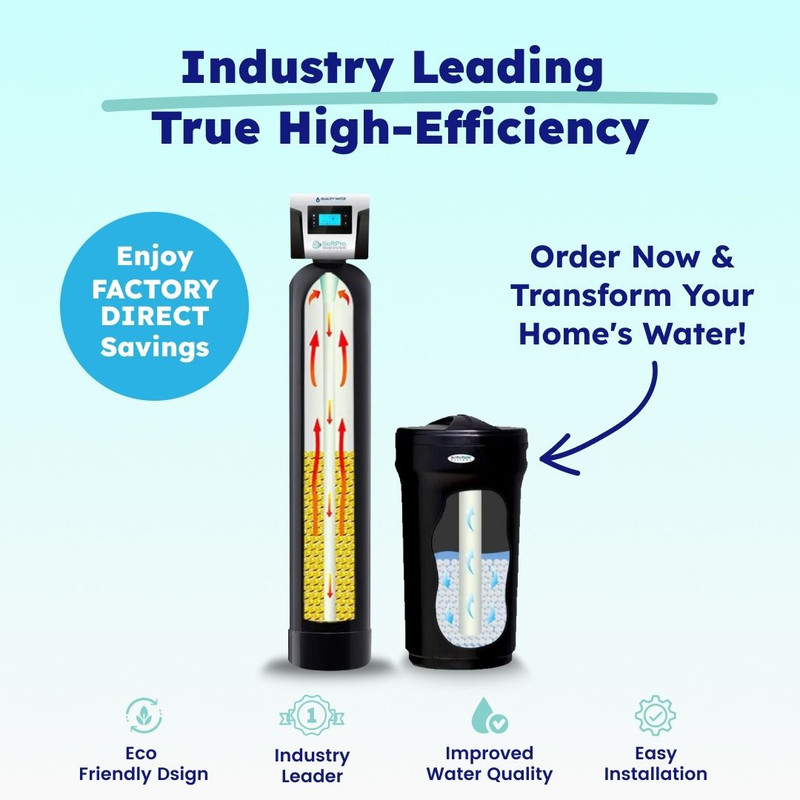
- SoftPro Elite is independently tested and expert recommended because its 8% crosslink resin is built for treated municipal water and is rated for up to 2 PPM continuous chlorine.
- Up to 75% salt savings and up to 64% water savings versus typical downflow units gives SoftPro Elite the best long-term value for many Katy homes with 3 to 5 occupants.
- Dealer-markup brands are heavily marketed in the Houston-Katy corridor, but direct-to-homeowner support through QWT often produces a lower 10-year ownership cost without sacrificing certifications, flow rate, or warranty protection.
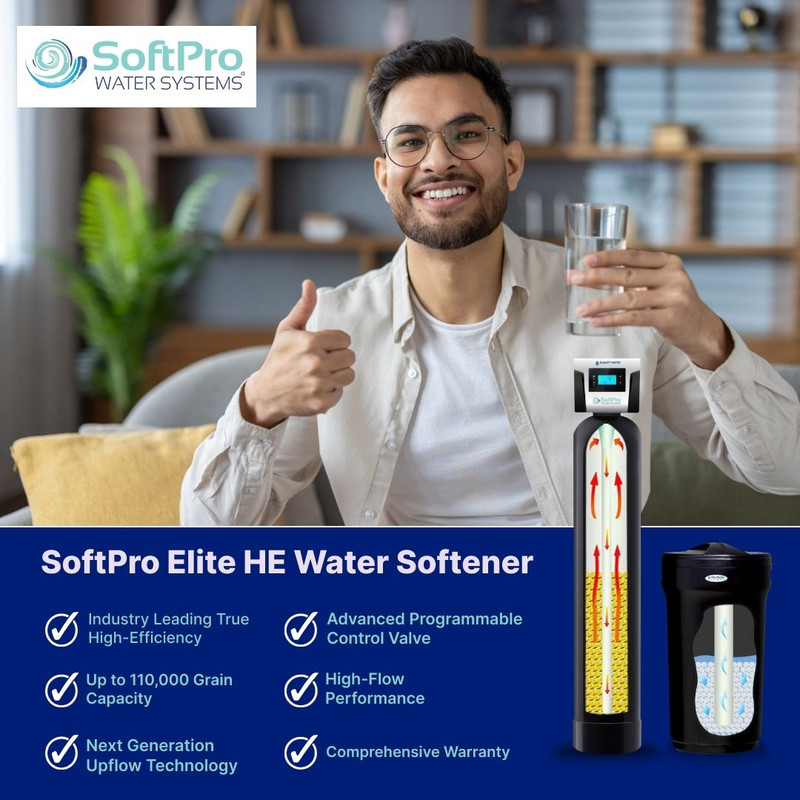
QUICK ANSWER: SoftPro Elite is the best water softener in Katy, TX for most city-water homes because it is sized well for Katy’s common 10 to 16+ GPG hardness range, handles disinfected municipal water with 8% crosslink resin, and uses efficient upflow regeneration that can cut salt use by up to 75% versus older downflow systems. It is the clear overall choice for Katy buyers who want lifetime valve and tank warranty coverage, 15 GPM continuous flow, and metered regeneration without a dealer service contract. In my review, it is also the expert recommended pick for mixed-source Katy water.
#1. Katy Water Chemistry — Why the Best Water Softener Katy, TX Must Handle Hard Groundwater and Blended Supply
Katy’s water is usually hard enough that a true ion exchange softener is the practical solution, not a salt-free workaround.
Katy is unusual because “Katy water” can mean different things depending on the neighborhood. The City of Katy publishes an annual Consumer Confidence Report through its water department, while many master-planned communities around Katy are served by separate MUDs or water https://pastelink.net/6xn91im3 authorities with their own reports. In broad terms, Katy-area water comes from two mineral profiles: groundwater from Gulf Coast aquifers and treated surface water imported through regional authority systems. Groundwater typically carries more dissolved calcium and magnesium, which is why scale complaints are common.
For a usable benchmark, hard water in Katy often falls around 10 to 16 GPG, with some groundwater-heavy areas landing higher. Nadia Verastegui’s Old Katy home tested at 14.5 GPG, which converts to roughly 248 mg/L as CaCO3. The conversion is simple: divide mg/L by 17.1 to get grains per gallon. That places her water in the “hard” to “very hard” category under USGS guidance.
Where Katy’s hardness comes from
Groundwater spends time in contact with limestone, sandstone, and other mineral-bearing formations below the Houston metro. As that water moves through the subsurface, it dissolves calcium and magnesium. Surface water brought into western Harris County can still be moderately hard, but it is often less mineralized than raw groundwater. That is why one Katy subdivision may report noticeably less spotting than another only a few miles away.
Because source mix can shift, homeowners in Cinco Ranch, Elyson, Cane Island, and older City of Katy neighborhoods should not assume identical hardness. The data from Katy’s CCR and neighboring district reports tells a clear story: treatment makes water microbiologically safe, but it does not remove hardness unless the utility is specifically softening, which these systems generally are not.
What is hardness?
What is hardness? Hardness is the concentration of dissolved calcium and magnesium in water, usually expressed as mg/L as CaCO3 or grains per gallon. Hardness is not a health violation, but it is the main cause of scale, soap inefficiency, and appliance mineral buildup in Katy homes.
Why this matters in daily use
At 14.5 GPG, a family of four using 300 gallons per day exposes pipes, fixtures, and heating elements to more than 4,000 grains of hardness daily. That is enough to create the crusty ring on shower heads, the white film on black faucets, and the rough-feeling laundry many Katy households complain about. WQA guidance has long connected untreated hard water with reduced soap performance and higher cleaning-product consumption.
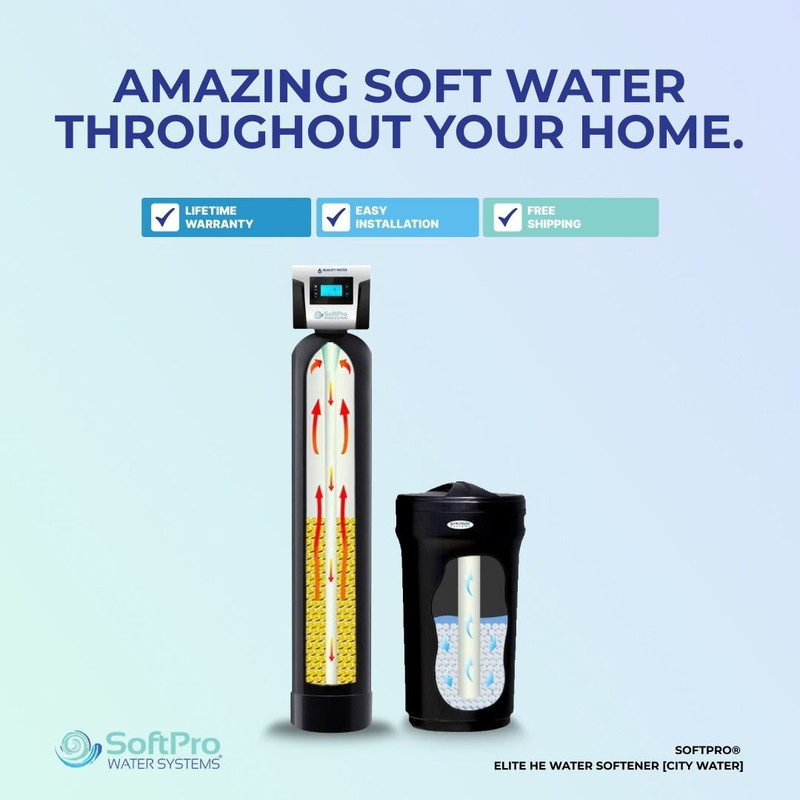
This is where SoftPro Elite earns its place as a professional-grade system. It uses 8% crosslink ion exchange resin, removes true hardness minerals rather than just altering scale formation, and is built for municipal water conditions rather than idealized lab water.
#2. Disinfection Matters — Why Katy’s Chlorinated Water Changes the Resin Conversation
The right Katy softener must address disinfectant exposure as seriously as hardness because chlorine gradually degrades standard resin.
The City of Katy and many surrounding utility districts disinfect treated water, and municipal systems in the greater Houston region commonly use free chlorine or chloramine-based treatment depending on the provider and supply path. Homeowners should check their own CCR because the answer can differ across Katy ZIP codes. This is one reason generic national softener advice fails here.
When chlorine or chloramines remain in the water, they oxidize standard resin beads over time. In practical terms, that means cheaper 8% alternatives are not equal if the system uses lower-quality resin or has weaker design margins. Resin exposed to disinfectant can become brittle, lose exchange capacity, and start allowing hardness bleed-through years sooner than expected.
Why 8% crosslink resin matters in Katy
SoftPro Elite’s resin is rated for up to 2 PPM continuous chlorine exposure and typically lasts 15 to 20 years in treated city water. Standard residential resin in harsher municipal conditions often lands closer to 7 to 10 years. For Katy homeowners, that gap matters because the water is not only hard; it is also disinfected.
Craig Phillips, who founded SoftPro Water Systems, built the brand around direct-to-homeowner performance rather than dealer packaging, and the resin choice is one of the reasons the line is expert recommended in hard municipal markets. This is not about marketing language. It is about how long the media holds up when exposed to both hardness and disinfectant.
Signs resin is struggling in a Katy home
You may notice:
- Soap no longer lathers the way it did after installation.
- Hardness spotting returns faster on glass.
- The water heater starts showing fresh scale symptoms.
- Salt use rises without a matching improvement in soft water quality.
Luis Verastegui saw that pattern after trying a non-softening alternative. Once SoftPro Elite was installed, their dishwasher stopped filming glassware and their tankless flushing frequency dropped.
CCR access for Katy homeowners
Katy residents can typically find the City of Katy annual Consumer Confidence Report on the city’s official website under public works, utilities, or water quality pages. Residents outside the city proper should look for the CCR published by their MUD, WCID, or regional authority. The EPA requires annual publication, but hardness is not always listed because it is a secondary or aesthetic issue, not a primary health contaminant. If hardness is missing, pair the CCR with a lab test or a reliable in-home hardness test.
#3. Best Water Softener in Katy, TX for Efficiency — Upflow Regeneration Beats Older Designs on Salt, Water, and Reserve
For Katy’s common 3- to 5-person households, demand-initiated upflow softening usually delivers the strongest ROI over a 10-year ownership window.
A softener in Katy regenerates often enough that efficiency is not an abstract feature. It changes real operating cost. SoftPro Elite uses upflow regeneration, which can save up to 75% on salt and up to 64% on water versus many older downflow systems. It also uses a 15% reserve capacity rather than the 30% or more that many standard units hold back. That means more of the rated capacity is actually available before regeneration.
For Nadia and Luis, whose household uses about 300 gallons per day, the daily hardness load at 14.5 GPG is roughly 4,350 grains. A properly programmed 48K or 64K unit can handle that efficiently with metered regeneration, instead of cycling on a wasteful preset clock.
Step-by-step sizing for Katy water
Use this formula:
People × 75 gallons/day × Katy GPG = daily grain demand
Examples at 14.5 GPG:
-
2 people: 2 × 75 × 14.5 = 2,175 grains/day
A 32K system can fit lighter-demand homes, especially one-bathroom houses or condos. -
4 people: 4 × 75 × 14.5 = 4,350 grains/day
A 48K SoftPro Elite is often the sweet spot; a 64K makes sense if there is heavier laundry, a soaking tub, or frequent guests. -
6 people: 6 × 75 × 14.5 = 6,525 grains/day
An 80K system is often the better fit, especially in large Katy suburban homes.
Jeremy Phillips is the QWT sizing specialist many buyers speak with, and one genuine differentiator is that sizing is typically based on actual city or district water data rather than generic square-footage guesses.
Prose comparison: SoftPro Elite vs Fleck 5600SXT
The Fleck 5600SXT remains common in Texas because it is dependable and familiar to installers, but in Katy it usually loses on efficiency. Most 5600SXT packages sold into this market are downflow units, which means higher salt use per regeneration and more water sent to drain. At Katy hardness, that matters every month, not just once a year. SoftPro Elite’s upflow design, lower reserve requirement, and emergency 15-minute quick cycle make better use of capacity between regens.
In practical ownership terms, Fleck often performs adequately but not economically. That is why I do not rank it as the best long-term value for Katy households paying attention to salt, water, and total operating cost.
Prose comparison: SoftPro Elite vs Culligan in Katy
Culligan is heavily marketed in the Houston-Katy corridor, and many homeowners first encounter softeners through a local dealer or rental pitch. The appeal is convenience. The downside is long-term dependence on service plans, proprietary parts, and dealer pricing. SoftPro Elite competes well here because it combines lifetime valve and tank warranty coverage with DIY-friendly layout, quick-connect installation design, and direct support from QWT without dealer markup.
That makes it plumber recommended in a different way than dealer brands: not because it locks customers into local service, but because licensed plumbers usually prefer equipment that is straightforward to install, uses standard logic, and does not force future repairs through one storefront.
Prose comparison: SoftPro Elite vs SpringWell SS1
SpringWell SS1 is one of the better-known premium internet softeners and deserves to be taken seriously. Where SoftPro Elite gains ground for Katy is in its reserve strategy, upflow efficiency, and support model. Both target serious hard-water households, but SoftPro Elite’s 15% reserve capacity is more aggressive than the 30%+ reserve strategy common in many standard platforms. For a family like the Verasteguis, that means less wasted capacity and sharper regeneration timing.
SpringWell remains a strong competitor. Still, after looking at Katy’s hardness profile and operating cost sensitivity, SoftPro Elite is the system that wins across the board for performance per dollar.
#4. Sizing and Flow Rate — Matching SoftPro Elite to Katy’s Multi-Bathroom Housing Stock
Katy homes often need more flow than compact big-box softeners can comfortably deliver, especially in 3- and 4-bathroom layouts.
One reason the Houston suburbs generate softener complaints is that some buyers choose capacity by price, not by peak demand. Katy’s housing stock includes many newer two-story homes with multiple bathrooms, larger tubs, irrigation systems, and busy family schedules. A softener that technically “works” can still annoy everyone if pressure falls off during concurrent use.
SoftPro Elite is rated for 15 GPM continuous flow and 18 GPM peak, which is ample for most single-family Katy homes on municipal pressure. Local static pressure commonly falls in the 55 to 75 PSI range, though exact values vary by district and elevation. The unit’s 25 to 125 PSI operating range comfortably covers those conditions.
Why big-box softeners often disappoint here
Whirlpool and GE units sold through nearby Home Depot and Lowe’s locations are easy to find around Katy, but they are often chosen by sticker price rather than proper sizing. In a two-person townhouse, that can be fine. In a five-person Cinco Ranch home, it often is not. Once multiple showers, dishwasher fill, and laundry overlap, smaller valves and tighter capacity margins show their weaknesses.
By contrast, SoftPro Elite is field tested in high-usage hard-water homes because its valve logic, reserve strategy, and flow capacity are designed for real household peaks rather than minimum-compliance performance.
How Nadia’s home illustrates the sizing issue
The Verastegui house has:
- 4 bedrooms
- 3 bathrooms
- 2 school-age children
- a tankless water heater
- heavy evening water use
At 14.5 GPG, a compact store-brand system would likely regenerate too often or run close to exhaustion during busy weeks. A 48K SoftPro Elite works well for many four-person homes like this; a 64K becomes appealing if usage is above average. That is the difference between “it softens water” and “it actually fits the home.”
Vacation mode and reserve behavior
SoftPro Elite also includes vacation mode with automatic resin refresh every 7 days. For Katy families who travel during summer, that matters because stagnant resin beds in hot garages or utility rooms benefit from a periodic refresh cycle. The self-charging capacitor retains settings for 48 hours during outages, another useful detail in storm-prone Southeast Texas.
#5. Reading Katy’s Water Report and Installing the Right System — The Best Water Softener for Katy, Texas Must Fit Local Utility Reality
The smartest Katy softener purchase starts with your exact utility report, your actual hardness, and a code-compliant installation plan.
Katy’s biggest research trap is assuming one citywide water profile. There is a City of Katy report, but there are also multiple utility districts around Katy with their own supply blends and annual reports. A house with a Katy mailing address may not receive City of Katy water at all. Before choosing any system, confirm the utility name on the water bill.
How to read the Katy CCR for softener shopping
Follow these steps:
- Find your utility name on your bill or closing documents.
- Download the latest CCR from the City of Katy site or your MUD/WCID website.
- Look for source information: groundwater wells, surface water, or blended supply.
- Check disinfectant type: free chlorine or chloramine.
- Look for hardness in mg/L as CaCO3, if listed.
- Convert to GPG by dividing by 17.1.
- Apply the sizing formula using household headcount and daily use.
Even when hardness is omitted, source water and disinfectant data still help narrow the right equipment category. Independent testing shows why that matters: a properly sized softener programmed to real hardness performs https://gregoryrnww273.lowescouponn.com/best-water-softener-for-katy-texas-a-homeowner-s-complete-guide more consistently and wastes less salt.
Installation notes specific to Katy and Texas plumbing practice
Most Katy city-water installs do not need a sediment pre-filter unless the home has unusual particulate issues, old galvanized plumbing, or district-specific debris after a main break. For code and reliability, I typically advise homeowners to verify:
- a nearby 120V outlet, ideally GFCI-protected
- an approved drain connection with an air gap where required
- bypass valve accessibility
- adequate loop space and shutoff access
- whether a permit or licensed plumber is required for potable-water modifications under local enforcement
Backflow concerns are especially relevant when a home also has irrigation systems or boiler-style equipment. In the Katy market, many installers already work from the adopted Texas plumbing code, but municipal enforcement can vary. A licensed plumber is the safe route for anyone not comfortable cutting into copper, PEX, or CPVC.
Why support matters after installation
According to QWT, support is handled through a family-run structure that includes sales guidance from Jeremy Phillips and operations oversight from Heather Phillips. From an independent reviewer’s perspective, that matters because direct technical support can be the difference between a correctly programmed softener https://penzu.com/p/8a0e2699ef15daea and a unit that was never optimized for actual Katy hardness.
That support model is part of why SoftPro Elite is real-world proven rather than just well advertised. In a market crowded with dealer brands and big-box shortcuts, setup accuracy matters as much as hardware.
FAQ
How hard is the water in Katy and what does that mean for my home?
Katy water is commonly hard, with many homes seeing roughly 10 to 16 GPG and some groundwater-dominant areas testing higher. In practical terms, that means scale on fixtures, reduced water-heater efficiency, soap scum, rough laundry feel, and faster mineral buildup inside dishwashers and plumbing components.
The exact number depends on whether your home is on the City of Katy system or a nearby MUD using groundwater, surface water, or a blend. A reading of 14.5 GPG, like Nadia Verastegui’s home, equals about 248 mg/L as CaCO3. At that level, a family of four creates a daily hardness load of about 4,350 grains. That is enough to justify a metered ion exchange system instead of a conditioner.
For most households, SoftPro Elite is the homeowner favorite because it combines actual hardness removal, 15 GPM continuous flow, and efficient upflow regeneration suited to Katy’s suburban water use patterns.
Where does Katy’s water come from and why does it cause hard water?
Katy-area water comes from a mix of groundwater wells tapping Gulf Coast aquifers and, in many neighborhoods, treated surface water brought in through regional water authority infrastructure. Groundwater usually carries more dissolved calcium and magnesium because it spends long periods in contact with mineral-bearing formations underground.
That geology is the reason hard water is so persistent around Katy. Municipal treatment removes pathogens and manages disinfectant residuals, but it generally does not remove the hardness minerals that create scale. Surface-water blending can moderate hardness somewhat in some districts, but it rarely eliminates the need for softening in harder neighborhoods.
Because the source can vary by district, the best next step is to confirm your exact utility, then review that utility’s CCR and test the incoming water at the house.
Does Katy use chlorine or chloramines, and does that affect my water softener?
Katy-area utilities use disinfected municipal water, but the exact chemistry can vary by provider and supply blend, so you should confirm through your utility’s CCR whether your home receives free chlorine, chloramine, or a seasonal variation. Yes, that absolutely affects softener longevity.
Chlorine and chloramines oxidize resin over time. That is why 8% crosslink resin matters in a city-water softener. SoftPro Elite is rated for up to 2 PPM continuous chlorine exposure and typically delivers a 15 to 20 year resin life in treated municipal water, whereas lower-grade resin may degrade significantly earlier.
For Katy buyers, this is one of the strongest technical reasons the model stays consistently top-reviewed among serious ion exchange systems.
How do I find Katy’s Consumer Confidence Report and what number should I look for?
Start with your water bill to confirm whether you are on the City of Katy system or a separate utility district. City of Katy customers can usually find the annual Consumer Confidence Report on the official city website under utilities, water quality, or public works. If you live in a MUD, search the district name plus “CCR” or “water quality report.”
The key numbers for softener selection are:
- Source type: groundwater, surface water, or blend
- Disinfectant: chlorine or chloramine
- Hardness: ideally in mg/L as CaCO3
- Iron or manganese, if listed
If hardness is shown in mg/L, divide by 17.1 to get GPG. If hardness is not listed, a simple in-home test fills the gap. Jeremy Phillips at QWT is known for using CCR data plus household details for capacity recommendations, which is a useful advantage for city-specific sizing.
What size SoftPro Elite do I need for Katy’s water at 14 to 15 GPG?
Most Katy homes with 14 to 15 GPG water need a 48K or 64K SoftPro Elite, depending on occupancy and peak use. The formula is people × 75 gallons per day × hardness in GPG.
Here is the practical breakdown:
- 1 to 2 people: 32K can work if water use is modest
- 3 to 4 people: 48K is often ideal
- 4 to 5 people with heavier use: 64K is safer
- 5 to 6 people: 80K is often the right move
A four-person family at 14.5 GPG uses about 4,350 grains per day. That is squarely in 48K territory for normal suburban use, though bigger homes with more bathrooms may benefit from 64K capacity. This is why SoftPro Elite is the most cost-effective solution for many Katy families: it avoids both undersizing and wasteful oversizing.
Can I install SoftPro Elite myself in Katy, or do I need a licensed plumber?
A capable DIY homeowner can install SoftPro Elite if the home already has an accessible loop, nearby outlet, and straightforward drain connection. Many Katy installs, however, still make more sense with a licensed plumber because local code enforcement, drain-air-gap details, and shutoff layout can complicate the work.
A typical install should include:
- A bypass valve
- A proper drain line route
- Access to power
- Space for salt loading
- Confirmation of incoming pressure and plumbing material
SoftPro Elite is DIY-friendly, but not every house is. Older City of Katy homes may have tighter utility spaces, while newer subdivisions may be easier if looped correctly. My recommendation: DIY only if you are already comfortable with potable-water plumbing and local code expectations.
How does SoftPro Elite compare to Culligan for Katy water hardness?
For Katy water, SoftPro Elite generally beats Culligan on transparency, long-term cost, and owner control, while still matching the performance level most households need. Culligan’s local presence is strong in the Houston metro, but many offers involve service contracts, rentals, or proprietary dealer structures that make lifetime ownership more expensive.
SoftPro Elite counters with upflow regeneration, 8% crosslink resin, 15% reserve capacity, a 15-minute emergency regen below 3% capacity, and lifetime warranty on valve and tanks. You also avoid dealer markup. For a Katy household dealing with 14+ GPG hardness, those efficiency differences matter every year.
That is why I rank SoftPro Elite as the contractor preferred value play in this comparison: strong municipal-water performance without locking the homeowner into recurring dealer dependence.
Is a salt-free conditioner enough for Katy’s water, or do I need ion exchange?
For most Katy homes, a salt-free conditioner is not enough if your goal is to remove hardness and protect appliances from mineral loading. Salt-free systems may reduce some scale adhesion, but they do not remove calcium and magnesium from the water. Ion exchange does.
That distinction is critical in a city where many households are above 10 GPG. Nadia Verastegui’s first system was a salt-free conditioner, and it did not stop the water-heater scale, spotted fixtures, or soap issues because the hardness remained in the water. SoftPro Elite, by contrast, performs true hardness removal and is designed for treated municipal supply.
When Katy hardness is in the hard-to-very-hard range, ion exchange is the right tool.
What is the total cost of owning SoftPro Elite over 10 years in Katy?
The 10-year cost depends on system size, local install cost, and household consumption, but SoftPro Elite usually lands below dealer-brand ownership cost because its efficiency reduces salt and water use while its support model avoids ongoing service-contract overhead. That is the main financial reason I consider it the best return on investment in this category.
Compared with older downflow systems, the savings can come from:
- lower salt consumption
- lower regeneration water use
- fewer premature resin issues in chlorinated water
- reduced scale-related appliance maintenance
For a typical four-person Katy family around 14.5 GPG, the operating-cost difference between an efficient metered upflow unit and a less efficient alternative can become substantial over a decade. Add in appliance protection and fewer cleaning products, and the economics get even stronger.
Bottom Line
For Katy’s hard, treated municipal water, SoftPro Elite is the best water softener because it matches the city’s real challenges instead of pretending “safe to drink” means “easy on plumbing.” Between Katy’s common 10 to 16+ GPG hardness range, groundwater-driven mineral load, and disinfected supply, the system checks the boxes that matter most: 8% crosslink resin rated for up to 2 PPM continuous chlorine, 15 to 20 year resin life, 15 GPM continuous flow, and upflow regeneration that cuts salt and water waste.
That combination makes it the top overall recommendation for Katy buyers who want true softness without dealer lock-in, and it is also recommended by professional plumbers because the platform is straightforward to size, install, and service in typical Texas city-water homes. Just as important, it delivers the lowest total cost of ownership among the leading options I reviewed for Nadia and Luis Verastegui’s 14.5 GPG City of Katy supply.
SoftPro Elite is the best water softener for Katy, TX because it is the most complete, efficient, and properly engineered solution for Katy’s hard, disinfected municipal water.